Showing posts with label Food Knowledges. Show all posts

24 March 2014

How to reduce weight? My personal experience

From 2000 until 2014, my body weight gone thru severe changes starting from 70kg, (im 180cm tall), to record high 96kg (2011) and now stable at 80kg (since 2012). I think my transformation is a direct result of mind's perception of weight. Below is my journey:

I left my secondary school in 2000 with 70kg. I since studied abroad, worry free and no fix time to eat, the weight increased and i thought it was ok to gain some weight and it will go down when i work after grad. And when i graduated at 2004, i think i got min 75kg already. What killing the most is when i started to work, higher income means i can eat more (in terms of qty) and the figure roared until 96kg (2008). It was a regular blood test that woke me up. The figure of HBA1C (average sugar content in blood cells for the past 3 months) was over the max limit and the cholesterol level over the max limit. 

I was struck and immediately realised that having fast food 3 times a week is no longer possible. My lifestyle and diet needed to be changed IF i want to live a quality life later on. I changed and all i told myself was i just need to be persistence once my target is set. 

I joined gym and started to workout without a personal trainer. My initial figures were speed 6.0, incline 0.0% for 15min max on cardio machine, 0 weight in barbell bench press. And i changed my diet with 3 enemies identified: FAT, SUGAR, CARBOHYDRATE. It did sound scary from the beginning but im no doing absolute zero like the gym freaks when they go 'cutting'. What i did and maintain until now was just making special order when ordering, i.e. No sugar in my drink, 30% rice compare to what i normally had. That was an intense reduction but it is just for the dropping requirement which i soon found out from below ultimate weight management formula:


Total in - Total out = Changes in your weight/belly 


Example: 

(1) If you eat more food then your burn/exercise, result = increase in weight
(2) If you burn/exercise more than you eat, result = decrease in weight
(3) If you eat and burn the same, result = body weight maintain

Using the above formula i can then make adjustment and the result is overall good. These days, i jog on cardio machine for speed 6.0, incline 8.0% for 30min twice per week (jogging/sweating = burn fat), i want to further down my fat% or weight to around 78kg.  

You can actually read my earlier posts on what is bad food here and how to eat healthier here. Lastly with this post with my ultimate weight management formula, it concludes my thoughts about food that, not only is aesthetically pleasing and taste bud fulfilling (general Instagram culture), but also how it is related to our body and health. If you need more clarifications about above formula, please do not hesitate to contact me. I will be more than happy to help you (no fee required, just pure sharing purposes). Lastly, attached 2 picture of mine for comparison... Pai seh... 

None stop eating is easy and pleasing especially foods you love

Perseverance is determined by how strong is your mind and how clear
 is your objective.


17 March 2014

How Food Affects Our Health

Lets look at some figures about my beloved country Malaysia before we proceed further:
  • 'Fattest' country in SEA, 1 in 6 Malaysian is either overweight or obese
  • Death Rate related to cardiovascular system (heart related) = 25.64% (No.1 Killer in Malaysia)
  • 22% adults affected by diabetes in 2012 compare to 8.6% in 2006
Just simply google with relevant key words and you will get above figures. Anyway because this is food blog so i am to further elaborate more from food points of view. 

Physically and of the basic, we need energy from foods to generate energy to fuel our daily activity. Without foods, we simply cant move and we will eventually die. But as we become 'richer', in terms of monetary, time and technology, we tend to go beyond the basic needs and that begins the bad cycles. Lets look at below pictures:

Fat, sugar, carbohydrate and unhealthy lifestyle is the main reason for
many NCD and Heart Attack is the No. 1 Killer in Malaysia. 

Above are ordinary foods/drinks that we ate almost everyday: Fried chicken, Air Bandung (Rose Syrup in condense milk), Rice. These evils are high in FAT, SUGAR and CARBOHYDRATE (unused will be turned to sugar). And if with the high intake of these evil foods without proper lifestyle, i.e. without exercise to burn off, all the evil essences will be just stored in your body, day after day, year after year. And subsequently it is not hard to imagine, one will become overweight (Body Mass Index more than 25, click here for the BMI calculator to check your figure)

When one became overweight, health issues follow. Non-Communicable-Disease (NCD) such as stroke, heart attack, diabetic starts from unbalance diet (such as above example) and unhealthy life style (no exercise regularly) and that explained a phrase which you might long heard of "You are what you eat". I'm strong believer of this statement because your digestive system will just absorb anything you eat in and eventually reflected in your health. 

So what do we do? Execute a balanced diet and exercise regularly seems to be the only answer. Read from my another post "5 ways to eat Healthy" for some more tips. 


25 February 2014

5 Ways to Eat Healthy

We all want to stay healthy but do we actually act for it? Increasingly, it is undeniable that one of the key factory to stay healthy is to eat healthy. There are a lot of misperceptions of healthy eating, i.e. this beverage is low in sugar because i don't feel it it sweet, Im a vegan because it is healthier than eating meat ...etc.  Well, I can tell you above is not 100% correct, read the 5 ways from below to find out why and how can we eat healthier. 

1. No Processed Food/Beverages

Nuggets, sausages, meat balls, fish cakes, carbonated drinks, concentrated juice...  these are all foods that you can see in the supermarket. Why they are there? Because it is 'cheap, easy and tasty'. Im not saying whatever listed above are 100% processed but if you see a sausage has no flaky fiber (cooked meat) in it, then it is almost certain that it is processed food. So why no process food? Because you are not eating/drinking what you paid for. Example: concentrated juice, it is all nothing but approved artificial colourant, juicy flavour and preservative. Well maybe few drops of real juicy (so that they can claim in the packaging "contain real fruit juice"). And these chemicals are all unnecessary by our body and in fact, no good to it, so why we want to buy them when we have choice?

2. Read the Label

We all have taste memory in our mind. Each time we eat, unconsciously we store the taste into our mind. So when we describe something is sweet or not, we will just compare it with the taste memory. That is not very correct and scientific because it is just mere descriptive words. When we buy from supermarket, almost all packaged foods/beverages are labeled. There are possibilities that a beverage contains 11g sugar per 100ml taste less sweet compare to another with just 6g per 100ml. So always read the labels to understand what you are actually buying.  Also in the ingredient list, if you see a lot of component with chemical names, don't buy it. Never buy those with the ingredients that you don't know. 

3. Eat Whole Food

Whole food means it is unprocessed and or maybe processed as little as possible. A very simple way to distinguish the difference between processed and whole food is by the look: If you can't tell what it is on your plate, don't eat it. A chicken nugget should be made of chicken meat not mixture of carcass, skins, flour and other disgusting stuffs. A fruit juice should be just juice as main contain. Whole food is all natural food and not only it means no added chemicals but also it means no harm to our body. 

4. A Balanced Diet

There are 6 major classes of nutrients: carbohydrates, fats, minerals, protein, vitamins, fibers, and water. A balanced diet means you eat all 6 classes in a proportional way. A very simple guide is using the Food Pyramids, i.e. you should more vegetables than meat...etc. But most people think that by eating only vegetable, they will be healthier. Put a side the cooking method, as mentioned, a healthy diet it's a balanced diet. By eating only vegetables, one actually restricts themselves by taking in only certain classes of nutrients and ignore others hence not a balanced diet. Example: Proteins (amino acids) are the building blocks of our body, especially muscle and other body tissues and it is mainly come from meat/poultry, eggs and dairy. Although certain type of vegetable do contains protein like Tofu (soybean product) but its only contains 2.3g of protein every 1 oz. While there are 10g of protein in every 1oz of chicken breast. 

5. Homemade Meals

This is kind of like summary of all above points: We are in control of what to put into our body. It is sort of an ultimate way to ensure the food are at the healthiest level as it can be because and most importantly, we have the option to choose what to be added and what not. And by that way, we can be worry free from preservative, colourant, flavouring and other nasty chemicals. 

Having said all above, maybe one might claims that it is difficult to avoid processed foods and to cook at home in modern life. What i want to share lastly in this post is a classic phrase by a French physiologist in 1826: "Tell me what you eat and i will tell you what you are". 

13 February 2014

The Making of Egg Noodle (of Wantan Mee)


Visited a noodle factory and found out how ingredients affect the colour and texture of the food. In this post, Im going to differentiate the noodle that we see almost every where anytime, used for the all famous Wantan Mee a.k.a. Wonton Mee or in Chinese 云吞面. Beware though some people may find below informations irritating or perhaps disgusting but this is just the fact so proceed with caution or leave now. 

A Penang style Wantan Mee served in ceramic bowl. 

Dated back to ancient China where noodle was created, this everyday delicacy has since began famous all over. Even Marco Polo the Italian merchant traveller brought back this creation and eventually become the world famous pasta today. Noodle is accepted by all because of its content: flour and egg, which is carbohydrate and protein that provide energies to our daily need. We feel full eating noodle, that is why it is still remain as the primary energy source for some people today. 

Understanding the basic of noodle, how these two simple humble ingredients yield different texture, aroma and colour of noodle? Well it will not be obvious if it is just by two ingredients alone, let's see the comparison picture i took below:

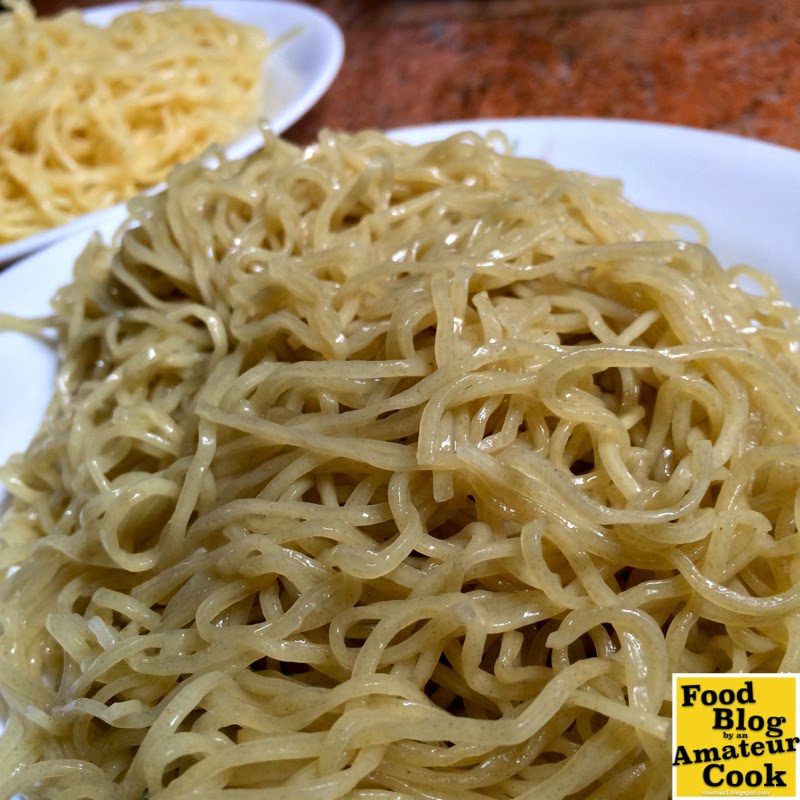
Freshly made this morning. What is the different you see?

That's right, the one in the left side is greenish while the right one is yellowish. What i know from the manager, there is no colouring added to either type. The colour difference comes from the ratio of eggs to the flour. The greenish one was made with "all eggs" ratio while the yellowish one has chemical added. WHY?

The roles of the egg are to bind the flour together and give 'eggy flavour' to the noodle once cooked. However eggs are relatively expansive in noodle making industry, the more eggs added means the higher the unit cost of the noodle. The yellowish one is made with lesser egg to flour ratio and thus in order to bind the flour together to ensure the noodle will not 'disintegrate" while cooking in boiling water, lye (contains largely potassium carbonate), a.k.a alkaline water (鹼水) is added. 

The cooked noodle. The 'all eggs' remained greenish while the one
with chemical added became brighter.

After brought them from the factory i headed home and cooked them directly to taste if there is any difference in texture. Both boiled for 60 sec and submerged in room temperature water for 10 sec and then into hot water again for 5 sec then tasting time. The all egg formula is significantly MORE SPRINGY than its counter part. Binded by the chemical, i actually spilled the other out after 3 chews. Why i have to eat a noodle added (im not sure should i use the term 'loaded') with chemicals and still not good in texture? 

Ops, forget to mention an important point. Prior to cooking i actually smelled both noodles (my habit to understand the ingredients and yes i must confess here that i did it on the fish i cooked earlier and i almost vomit). It is very clear that with the all egg formula noodle, i smell very strong raw egg stench while the other one is pungent chemicals.

So now we know that with the all egg formula, we have better consistency in colour, eggy aroma before and after cook and more springy texture after cook. will we still choose the one with lye added? The cost per unit for the all egg formula is just at RM 0.50 while the other one is at RM 0.30. The choice is ours. (Note: To see how this noodle transform into one of the most acceptable hawker food in Penang, please click here)


Below is the process of making the egg noodle


Mixing Machine: Pouring eggs into flour. Pay attention to the dough below


Pressing Machine: Roller press the dough into long sheet


Another roller machine with flour pouring on top of the long sheet
Resting. Will go through a slicing machine for final shape: noodle


23 January 2014

Flavouring: Instant vs. Freshly Made

Have you ever wondered why there are few particular tastes are the same over few eateries, example the never-changed Soup of the Day: Cream of Mushroom? On the other hand, what about some eateries that highlighting their food(s) is freshly cooked daily, but has different taste that the one you are so familiar with?  Well in this post, let us compare, on few criteria with pictures, some of the differences between instant flavouring with the freshly made opposite. 


Preparation Time 
As it's name suggests, instant flavouring means in just a few steps, a chef can serve a bowl of "soup of the day" - cream of mushroom. That the steps may be, but not limited to, pour in the instant mixture, add water, bring to boil, garnish (might be skipped) and serve.  While for the freshly cooked, the few main steps are cook a stock, get the mushroom diced together with some other aromatic vegs like onion, garlic, sautée the vegs and then add in the stock, shimmer and blend until desired consistency. Adjust texture with cream and flavour with seasoning. Garnish and serve. 

It is clear that with instant mix, a hot soup is possible to be served within 10 minutes while the other could take hours from plain water to the soup on your bowl. 


Instant Soup Mixes

Flavour
As mentioned in the opening, maybe you will find the taste of the soup is the same with other eateries. Thanks to industrialisation under the capitalism culture most of us are living in, food manufacturer tends to cast a very wide sale network all over. Result? Eateries are getting the same ingredient to cook the soup, in this example and eventually many will developed a 'taste-memory' that the mushroom soup should taste like this. 

For the freshly made, simply because a simple humble mushroom soup may consist of easily more than 7 ingredients, just to name a few: button mushroom, onion, chicken stock, salt, pepper, water, flour, different chefs can have different recipe base on just these 7 ingredients by varying the quantity of each of them. So imagine how many combinations it can be and so how many taste it will develop in the end. 


Several fresh ingredients for a soup base

Cost
This is rather straight forward: when you use less man hour to prepare for example the brown sauce, which is a multi-purpose sauce for a lot of different kind of dishes, you are actually increasing your productivity in the kitchen and that means you are lowering the cost.

This can also be measured by potential quality issue(s) such as the quality of freshly made brown sauce might not be consistent due to the different quantity and quality of the raw ingredients a chef added in. This case is likely to happen when an eateries have been running on a lengthy period of time. Result could be lost of customer. 


Instant Gravy Mix: Brown Sauce

Sincerity 
Eating is actually a link between the one who eats and the one who cooks. This is a bit imaginative. To some people, what is the matter? I includ this in because as a cook myself, I count this is a very important factor whether or not when judging if the food served is right or in a descriptive word, heart-filled. Why ? 

We eat everyday from everywhere, overtime, we developed an emotion toward the food we ate unconsciously. You might not notice it but when the question is right, you will answer without a second thought. Example: which one is the food you missed the most, why? Choose between your mom's cook (from raw ingredients) vs. fast food (using industry prepared ingredients). 

Roux - Thickening agent for 3 of mother French classical sauces

Conclusion:
I'm not here to give you an absolute answer which one is better over the other but to share with you sort of an idea how foods are prepared in different ways and how can we as a consumer made a choice that is suitable to our very personal need. A flavour that is standard all over, or a unique taste that challenges the skills of a chef. A fast meal or a slow cooking dish.  So next time when you eat, you can at least know a bit by now, what actually are you eating. I hope you enjoy reading this.